Harbour

The Harbour

To the harbour, he came

To be the same

He was willing to give up

his name and his fame

To the harbour...

He wanted to know, where should he dock

Where to trade ? He was hopeful of a gain, he came to trade. 

Be knew he better, that time ticks tock

A teacher does well, without a chalk

There is never a trade, his brain had fade

He thinks again , on the circular dot

How complete and rounded and same for all

Though some like to think big and small

There is no give up, and nothing to 'gain'


Cryptic confession

Normally i dont do something like this. There isnt any need to express, share, vent. The windows are closed always. The smoke gets absorbed in a carbon filter. We are carbon right. 

The filter needs cleaning from time to time but please stop thinking about the filter now and lets move on ? The  writer should not care about readers otherwise he ends up explaining or defending a bit too much. 

A judgement made few years back can reveal something about life and yourself, may be only now or still further in future. That seems to be an acceptable view but would that 'something' be acceptable. Probably yes, if you know you can handle it. You are a good carbon filter right ? 

You made a decision, you probably knew it was here good and there bad. You hoped still that you would still tune the outcome. The sentence needs addition and words will come at a price. The price is what you pay if the your decision doesn't help deal present and future. Still, still and finally still your share of good and bad has to be owed up by you. You cannot complain either as you are yourself not a spherical halo of divinity. 

Do you think you should change the outcome. Do you think its right to coursecorrect? Still, still and still ..


This Earth is His, to Him belong those vast and boundless skies;
Both seas within Him rest, and yet in that small pool He lies.

Which benchmark?

I do not write much about the topic i am writing about. This may not make a 'Wren and Martin' grammatical sense. But it is as 'present' as the moment between exhale and subsequent inhale of breath. Who are you. The quality of your life is your conversation with yourself (or may be with a mirror). If it is sounding direct and  giving direction to what is outlined here, you can be beware of what may be incidental. The writer does not have to be a philosopher to write something sober or arrogant. He writes in one blank state of mind on a blank slate.The primary motive is selfish for sure. But to what end. It is the purpose which defines us and paints two selfish men in different colors. If collection has to be done, thoughts must be collected. For they alone, are worth collecting.
I must be very careful not to miss chances life offers. I must pick all the pollens while sitting on the string,  pulsating in harmony with the rhythm of life. I see the photographs of the two hundred years old Scottish distilleries and inculcate their distillation finesse. Others may tell me that I miss a lot. But like them, i have my own limitations. In my case, i am sitting on the string and like to pulsate, drift for a while. But i try not to miss pollens. I throw the lumber like some Jerome K. Jerome. I sing like the solitary reaper, i open the door of every new day like the boy of 'Someone'. I also know of a coal miner who sometimes digs deep.There is no hurry. The coal miner returns unbothered by the coal. He relishes the food at the end of his day. Where are you sitting. What are you collecting. There are lot of ways to make honey.


One for the virtuoso - much like me :)


Raikkonen would rather be left alone


MONACO (Reuters) - Kimi Raikkonen would much rather be left alone but he is happy to admit that sometimes he does not know what he is doing.
Social media is never going to be the Finn's thing and the Lotus driver has never hidden his distaste for interviews but he overcame his reluctance and spoke to Reuters at the Monaco Grand Prix - albeit stressing: "That's not the reason why I am here.
"I am here for driving and racing and to try to win races and it's as simple as that," added Formula One's 2007 world champion and current title contender, his penetrating gaze shielded by sunglasses even inside the team motorhome.
Raikkonen's directness, his refusal to play the PR game and pretend to be someone he is not, may not have endeared him to all his sponsors over the years but his army of fans would not have it any other way.
They love the party animal who wants to be left alone, the technophobe who earns his living in the most technologically advanced sport in the world, the snowmobile racer and James Hunt fan with 'Iceman' tattooed in gothic script on his left forearm.
Beneath the taciturn exterior, and behind the growling monosyllabic replies in group interviews, Raikkonen is a racer who could be leading the championship after the weekend and is on course to chalk up his 23rd successive race in the points - one short of Michael Schumacher's all-time record.
LEAVE ME ALONE
On his way to victory in Abu Dhabi last year, the 33-year-old added to the legend that is Kimi Raikkonen by telling his race engineer over the radio in decisive terms to "leave me alone, I know what I'm doing".
The outburst spawned T-shirts and mugs with the phrase on it, one of the latter proudly owned by Frank Williams who tried to sign the Finn for his eponymous team in late 2011.
For many it has become Raikkonen's motto, but he does not see it that way.
"It's not that. For sure, sometimes I don't know what I am doing," he laughed, perhaps mindful of those old photographs of him drunkenly embracing an inflatable dolphin outside a nightclub or powerboat racing in a gorilla suit.
"But that happens to everybody. The whole story came out of proportion. It was a normal thing.
"It sounds like we are shouting, because the radio is not very good and you will shout as loud as you can to make sure that they hear what you say. It happens always. I am not a big fan of getting messages. I am sure I will ask if I need something.
"For sure it has happened in a Ferrari and a McLaren," he added. "I said many things but on those days you didn't get them on TV. Even now you get often in the races some odd things coming through but they don't put it in a live form for whatever reason. It's not like a new thing for the team."
That Raikkonen is not a big fan of unnecessary communication becomes even more evident when he is asked about other drivers' willingness to post photographs and put their private lives on display through social media.
"I don't use Facebook. If I could throw my phone away I would probably do it," he said. "It's always on silent and I don't like when it rings and people are calling.
"We could live without those things in the past when we just had a phone on the street somewhere, on the corner or at the house. I have no interest in telling all the people what I do every day and where I am.
"I want to do my stuff privately with my friends or family and that's it."
Surrounded by a backdrop of floating palaces swaying in the harbour, the Monaco Grand Prix tops the list of favourite races for many Formula One drivers.
Not Raikkonen.
An ideal race weekend, he suggested, would be at the Magny-Cours circuit in the heart of rural France - a now discontinued date on the calendar and unloved by sponsors and corporate types due to the dearth of hotels and nightlife.
"That was pretty nice. There were no people. The hotel is next door and it's a pretty good place. I always enjoyed it there. It was purely racing and not a big hassle," said Raikkonen.
The winner of the season-opening Australian Grand Prix is just four points behind Red Bull's triple world champion Sebastian Vettel after five of the 19 races and hitting the sort of form that brought him the title as a Ferrari driver.
Next season, he could even end up as Vettel's team mate if some of the paddock speculation is to be believed. Raikkonen is out of contract at the end of the year and was backed by the energy drink company when he quit F1 and switched to rallying at the end of 2009.
The Finn recognised he had options other than Lotus, who hope to keep him, but said having the best car would only be part of the equation when he came to decide.
WINNING CAR
"You always want to have a winning car but there is no guarantee that it will be," he said, mindful of the sweeping technical changes being introduced for 2014.
"Obviously they (Red Bull) have created a very good car for many years but we don't have such a bad car either so we cannot really say that if you go there it is certain that you will get the best car and will win always," he added.
"I think it is more the overall picture, that you have to have a good feeling in every aspect. You have to have a normal life, you have to have certain things in a certain place and it can be a small thing.
"It's just some simple thing that gives you overall happiness on all the things and how the life goes overall. That will make a difference and be the biggest effect on whatever the decision is."
Raikkonen entered Formula One with Sauber in 2001, with the then-president of the governing FIA Max Mosley concerned that the rookie lacked the experience to be granted the mandatory super-licence.
By the end of the year he was a McLaren driver, replacing double world champion compatriot Mika Hakkinen.
One more race win now would take Raikkonen's career tally to 21 and make him the most successful Finnish driver, in terms of grand prix wins.
Not that such statistics matter too much to him.
"I have already achieved something that I always wanted and anything I get more is nice," he said. "Of course we want to win more championships but if it doesn't happen or we don't get fastest laps or wins or whatever it will not change my life.

one for the blog..

Old article by Vir Sanghvi,

Most modern Indian cities strive to rise above ethnicity.Tell anybody who lives in Bombay that he lives in a Maharashtrian city and (unless of course, you are speaking   to Bal Thackeray) he will take immediate offence.We are cosmopolitan, he will say indigenously. Tell a Delhiwalla that his   is a Punjabi city (which, in many ways, it is) and he will  respond with much self-righteous nonsense about being the nation's capital, about the international composition of the   city's elite etc. And tell a Bangalorean that he lives in a   Kannadiga city and you'll get lots of techno-gaff about the   internet revolution and about how Bangalore is even more cosmopolitan than Bombay.But, the only way to understand what Calcutta is about is   recognize that the city is essentially Bengali. What's more,   no Bengali minds you saying that. Rather, he is proud of the   fact. Calcutta's strengths and weaknesses mirror those of   the Bengali character. It has the drawbacks: the sudden   passions, the cheerful chaos, the utter contempt for mere   commerce, the fiery response to the smallest provocation.And it has the strengths (actually, I think of the drawbacks   as strengths in their own way). Calcutta embodies the Bengali love of culture; the triumph of intellectualism over   greed; the complete transparency of all emotions,the disdain with which hypocrisy and insincerity are treated;the warmth of genuine humanity; and the supremacy of emotion   over all other aspects of human existence.That's why Calcutta is not for everyone. You want your cities clean and green; stick to BANGLORE. You want your cities, rich and impersonal; go to Bombay. You want them high-tech ;hydrabad is your place. But if you want a city with a soul:come to Calcutta.When I look back on the years I've spent in Calcutta.I don't remember the things that people   remember about cities. When I think of London, I think of   the vast open spaces of Hyde Park. When I think of New York,   I think of the frenzy of Times Square. When I think of Tokyo, I think of the bright lights of Shinjiku. And when I   think of Paris, I think of the Champs Elysee. But when I   think of Calcutta, I never think of any one place. I don't   focus on the greenery of the maidan, the beauty of the Victoria Memorial, the bustle of Burra Bazar or the splendour of the new Howrah 'Bridge'. I think of people.Because, finally, a city is more than bricks and mortars,   street lights and tarred roads. A city is the sum of its   people. And who can ever forget - or replicate - the people of Calcutta?I was told that the city   would grow on me. What nobody told me was that the city   would change my life. It was in Calcutta that I learnt about   true warmth; about simple human decency; about love and   friendship; about emotions and caring; about truth and honesty. I learnt other things too. it was a revelation to live in a city where people   judged each other on the things that really mattered;where   they recognized that being rich did not make you a better   person - in fact, it might have the opposite effect.I learnt also that if life is about more than just   money, it   is  about the things that other cities ignore; about culture,   about ideas, about art, and   about passion. In Bombay, a man with a relatively low income   will salt some of it away for the day when he gets a stock   market tip. In Calcutta, a man with exactly the same income   will not know the difference between a debenture and a dividend. But he will spend his money on the things that   matter. Each morning, he will read at least two newspapers   and develop sharply etched views on the state of the world.Each evening, there will be fresh (ideally, fresh-water or   river) fish on his table. His children will be encouraged to   learn to dance or sing. His family will appreciate the power   of poetry. And for him, religion and culture will be in   inextricably bound together.Ah religion! Tell outsiders about the importance of Puja in   Calcutta and they'll scoff. Don't be silly, they'll say.Puja is a religious festival. And Bengal has voted for the   CPM since 1977. How can godless Bengal be so hung up on a   religions festival? I never know how to explain them that   to a Bengali, religion consists of much more than shouting   Jai Shri Ram or pulling down somebody's mosque. It has little to do with meaningless ritual or sinister political activity.The essence of Puja is that all the passions of Bengal converge: emotion, culture, the love of life, the warmth of   being together, the joy of celebration, the pride in artistic ex-pression and yes, the cult of the goddess.It may be about religion. But is about much more than just   worship. In which other part of India would small, not particularly well-off localities, vie with each   other to produce the best pandals? Where else could puja   pandals go beyond religion to draw inspiration from everything else? In the years I lived in Calcutta, the pandals featured Amitabh Bachchan, Princes Diana and even   Saddam Hussain! Where else would children cry with the sheer   emotional power of Dashimi, upset that the Goddess had left   their homes? Where else would the whole city gooseflesh when   the dhakis first begin to beat their drums? Which other   Indian festival - in any part of the country - is so much   about food, about going from one roadside stall to another,   following your nose as it trails the smells of cooking?Certainly, you can't do it till you come and live here, till   you let Calcutta suffuse your being, invade your bloodstream   and steal your soul. But once you have, you'll love Calcutta forever. Wherever you go, a bit of Calcutta will go with   you. I know, because it's happened to me.And every Puja, I  am overcome by the magic of Bengal. It's a feeling that'll  never go away.

idle thought on valuation

When in my usual numb and dumb state, i think about valuation ( so i think in my numb state, hypocratic statement), first lines that come to mind are:

i. nothing less than Mergers & Acquisitions
ii Buyer synergies
iii One can debate endlessly ( with other person of course) about the difference between Fair Value and Fair Market Value
iv. Even Trading and Hedging do not escape valuation.
v. To quote from Adkins , Matchett and Toy, " valuation is fundamental to nearly every aspect of finance"

Valuations are needed for stand alone firms or for combined entities for
mergers
acquisitions
company sales
start-ups
joint ventures
share-option programs
IPOs
re-capitalization
etc

Basically, wherever and whenever there is a transaction, we might need a valuation.

When two boys do a transaction in a playground ( purchase of a cricket ball in return for a promise of a homework or for some money), they are evaluating.

Since, in large organizations, lot of people are involved, transactions such as these have given opportunities to some other firms and persons to claim some consultation fee.
There are mainly two things to care about in any situation:
i Your own basics on how the company works, what different financial terms and numbers mean
ii what is the proposed transaction

Sometimes, a third point you need to care about is the legal/ regulatory aspect.

People who are experienced enough can think of transactions that comply with laws as well as provide maximum possible benefit to their clients.

Most of our intelligence is required only to know our basics and to fully understand the transaction. We all succeed with varying degrees on these two accounts. There is very little 'creative' about finance. It is in general more about retaining your fragile understanding. And definitely, there is nothing that is out of our intuitive reach.


Some One


                                     Some One

Some one came knocking
At my wee, small door;
Someone came knocking;
I'm sure-sure-sure;
I listened, I opened,
I looked to left and right,
But nought there was a stirring
In the still dark night;
Only the busy beetle
Tap-tapping in the wall,
Only from the forest
The screech-owl's call,
Only the cricket whistling
While the dewdrops fall,
So I know not who came knocking,
At all, at all, at all.

Of leaders and leadership

Level 7 leadership

With more and more people realizing the importance of everyday leadership, theories continue to evolve around the inherent traits and qualities displayed by the leaders. One of the well known matrix, the 9x9 managerial grid, by Blake and Mouton,

has been in use for sometime now to categorize the managers according to the extent of their orientation towards people and productivity. Another piece of work done by Harvard Working Knowledge categorizes six levels of leadership- sociopath, opportunist, chameleon, achiever, builder and the transcendent. These classifications are differentiated by their long term goals  they seek to achieve and somewhat, also by the measures these leaders take to attain these goals. The sixth level of leadership encompasses a large group comprising departments, divisions, companies and perhaps societies. To what end does this kind of leader works is not very well established but transcendent leaders affect the thought process and functioning of a large and a diverse group. A demagogue like Adolf Hitler and a spiritual leader like Dalai Lama may be placed in this category.
If we think of the traits that successful leaders, and not necessarily very popular leaders, have, we may come across many attributes with varying shades. Attributes like technical skills, planning,good communication skills, result-orientation, team-building, conscientiousness, extroversion, empathy, risk taking ability etc. Whether all or some of these are present in the leaders depends on the purpose they are serving. They have a goal in front of themselves and they imbibe one or more of these attributes to be successful. All of this is well known. There may a case for a leadership at highest level, where a leader may never exhibit these common traits. For example, he may possess technical skills, communication skills etc but still self-train himself to keep all of such qualities in some corner of his mind from where these would not appear to guide his central thought process. It is like a person acting as if he is devoid of any thoughts and skills. Such a person can be generally ineffective if he actually knows nothing. But if the person knowingly keeps all his qualities at bay, then he may be doing the best thing for he will not be hindered by any biases. His qualities will come to fore once his central idea becomes clear to him. Execution of his idea will definitely need all other qualities like communication, monitoring mechanisms, technical know-how etc.The best attribute such a leader would possess will be that he has none! One example that come to the mind is that of Mughal invader and Emperor Babur. Babur knew that he was outnumbered by the Rajputs led by Maharana Sangram Singh.   He also knew that Rajputs were very good warriors. He could have approached his men and tried to inspire them all days and nights; he could have told them that they had been successful against the Lodhis of Delhi, that they had cannons which the Rajputs didn't possess. He gave a  totally different angle to his speech that proved to be so effective that it eventually established Mughal rule in India.

best snippet

Nothing Gold Can Stay

Nature's first green is gold, 
Her hardest hue to hold. 
Her early leaf's a flower; 
But only so an hour. 
Then leaf subsides to leaf. 
So Eden sank to grief, 
So dawn goes down to day. 
Nothing gold can stay. 

                                ------Robert Frost

Into my own

ONE of my wishes is that those dark trees,
So old and firm they scarcely show the breeze,
Were not, as ’twere, the merest mask of gloom,
But stretched away unto the edge of doom.

I should not be withheld but that some day
Into their vastness I should steal away,
Fearless of ever finding open land,
Or highway where the slow wheel pours the sand.

I do not see why I should e’er turn back,
Or those should not set forth upon my track
To overtake me, who should miss me here
And long to know if still I held them dear.

They would not find me changed from him they knew—
Only more sure of all I thought was true.


------Robert Frost

Free mind


A virtuoso can detect definitively, unfailingly some coherence. What i do, where i go, i may be subjected to new people, ideas. But it is that beauty of relaxed mind that nothing new seems to be happening barring few actions around me. Whatever has to happen and is happening around has already been discounted by mind and thus, it renders almost all data floating around me, meaningless. Consequently the radar system in my head has grown extremely strong to catch anything what may appear to me; important , or funny or curious. and nowadays happiness comes only from nothingness and awareness of nothingness. I just avoided the word 'void' as it has negative connotations for many. But even avoid has a void, to give an example of my earnest desire. It is almost like i have been sailing through crowd around me daily, effortlessly separating noise from myself. No accident that i was laughing in the elevator thinking about some silly office love affairs going on. The most useless of things catch my attention, sometimes. I must here admit that this state is not exclusive to me, and countless people experience it for a short period of time. But a large portion of those people are either in pain, or want to get out of it soon to seek some smile based on tangible reasons. These are the people who make efforts to get out of puddles in the road. Laziness and, the tenet of rejection of any sort of effort, is what enriches my thinking and adds consistency in my case, which happily, is very good. I think Ravana's brother kumbhakaran must also have reveled in the same state for his lifetime. Perhaps this was why staying awake did not add much value to him. ( Well, that was extreme ! )

reuters- tennis wrap up stats

WRAPUP 1-Tennis-Nadal seals magnificent seven


PARIS, June 11 | Mon Jun 11, 2012 7:57pm BST

(Reuters) - A gaping hole on a smashed-up on-court bench bore testament to how maddening it is to play Rafa Nadal at Roland Garros as the Spaniard was hailed as the 'greatest ever claycourt player' after hoisting the French Open trophy for a record seventh time.

Novak Djokovic found plenty of uses for his racket during a soggy final which spilled into a second day on Monday. The world number one slammed it to the ground, sent debris flying everywhere after smashing it into his courtside bench and even whacked his head repeatedly with it.

But it simply could not conjure the strokes that would have allowed the Serb to become the first man in 43 years to win four grand slams in a row and instead Djokovic, with a sore head and tortured soul, fired a double fault that prompted Nadal to sink to his knees following a 6-4 6-3 2-6 7-5 victory.

The high-stakes showdown had started at 1517 local time on Sunday under menacing grey skies, was contested mainly through driving rain, and ended almost 23 hours later in a sudden burst of sunshine with a triumphant Nadal curled into a foetal position in the most famous arena in claycourt tennis.

On a court that has become a private stage for his jaw-dropping skills, Nadal eclipsed the record he shared with Bjorn Borg and showed the man who had defeated him in the last three grand slam finals that this was his stomping ground.

But unlike Borg, who quit the sport at 26, the same age as Nadal is now, the insatiable Spaniard still hungers to extend his astonishing Roland Garros run which now stands at 52-1, with a 7-0 record in the finals.

"He's definitely best player in history on this surface, and results are showing that he's one of the best-ever players that played this game," Djokovic told reporters after his 27-match winning streak at the slams was ended by Nadal in the three hours 50 minute duel.

Nadal, though, was not feeling so invincible when he woke up on Monday morning with a 6-4 6-3 2-6 1-2 lead.

As far as he was concerned, the thought of joining Australian Jack Crawford as the only man to have lost four successive slam finals, was the stuff of nightmares.

"I had lost three grand slam finals in a row to him. If I had lost a fourth final, this would have been very difficult for me," said Nadal, who had reached the Paris showpiece without dropping a set. "I was very nervous all night. So in my mind, this was the final I had to win."

He need not have worried as after only 50 minutes of action on Monday, he was once again cradling the Musketeers' Cup and running his fingers down the list of champions on the metal plate at the base of the trophy, knowing that as of June 11 2012, his name will appear on it more than anybody else's.

EXCEPTIONAL ERA

Nadal might have rained down on Djokovic's parade - denying him the chance of doing something no man has done since Australian great Rod Laver in 1969, but at least Djokovic had the consolation of knowing that he is an intrinsic part of an exceptional era in men's tennis.

If there were any doubt about how this golden trio of Nadal, Djokovic and Roger Federer measure up to generations gone by, it seems that every time they step on a grand slam stage, there is a fresh deluge of eye-watering statistics.

They have now won 28 of the last 29 grand slams - it would have been 29-of-29 if Federer had not blown a two-sets-to-one lead against Juan Martin del Potro in the 2009 U.S. Open final.

All three players have been in a position to win four slams in row. Federer in 2006 and 2007, Nadal in 2011 and Djokovic this weekend. From 1969 to 2006, only Pete Sampras came close to pulling off the feat in the men's game in 1994.

The trio have also dominated the top ranking since Federer first climbed to the summit in February 2004.

"The sport is experiencing some really good times now. We're attracting a lot of attention because we have these two great players, and ... myself. We really have some charismatic players, a lot of personalities. This is good for tennis," said the world number one.

A French Open final that had so much riding on it proved tricky and exasperating for both players.

A day earlier tennis fans has seen the best and worst of Djokovic. But at least he had got his temper tantrums under control to fight back from two sets and a break down to win eight successive games as persistent drizzle turned the surface into a muddy mess.

That had left Nadal irritated, Djokovic rejuvenated and the encounter on a knife-edge with the Spaniard leading by two sets to one but a break down in the fourth as the finale headed into third-week finish for the first time here since 1973.

When the players returned on Monday, though, Roland Garros resembled a ghost-town with most of the boutiques in the grounds closed and only a handful of people milling around the alleyways.

It was not long before Nadal started to haunt Djokovic in a half-full Philippe Chatrier Court.

The Serb was left whacking his head with his racket within minutes of the restart as he went down break point after belting a forehand into the net to end a 21-shot rally.

Seconds later the Serb saw his 2-1 break advantage vanish after a leaping netcord allowed Nadal to blaze an audacious passing shot winner.

Djokovic raised his arm to slam another racket, but thought better of it. He smacked his head again with his racket after coming off second best in yet another 20-stroke plus rally, and complained bitterly to the umpire when the rain showers returned with Nadal just one game away from victory.

But the rain Gods were not willing to play ball with Djokovic on Monday and rapidly cleared away to allow Nadal to claim his moment of glory. (Editing by Toby Davis)

Of some expert narrative

PARIS -- Narratives are fluid, based on feel and perspective, passion and statistics and the momentum of the moment. All of which, when molded by different hands, can turn into some cousin of fact.

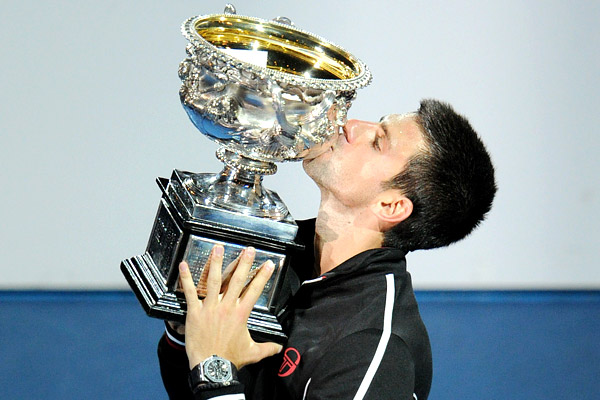
In January, Rafael Nadal was no longer the equal of Novak Djokovic -- or so we thought -- after the grueling 5-hour, 53-minute Australian Open final. Yet after a physically and mentally draining French Open run, Nadal resurrected this truth: He had never gone anywhere in the first place.

[+] EnlargeNovak Djokovic
Torsten Blackwood/Getty ImagesWhen Novak Djokovic won the Aussie Open final, we were left wondering whether Rafael Nadal would challenge him again.

"Don't forget that I've played the last five Grand Slam finals in a row. That's not victory. That's not a title, but that's fantastic results," Nadal said. "I played very bad in Montreal, Cincinnati. Yes, I played a great U.S. Open and I played probably bad in Shanghai and at the end of the season, but in the Davis Cup final I played great.

"You have to find your moments," he said. "With Novak, I say the same to me. It is not possible to be perfect every time, to be 100 percent every tournament. I'm going to keep having chances to win. I produced a lot of chances to win last year, but I lost almost every one."

For more than nine months, Nadal had not suffered a tennis problem as much as he had a Djokovic problem. Djokovic had not only taken Nadal's No. 1 ranking, but he took the Spaniard's air of invincibility on clay by beating him in the finals of the Madrid and Rome 1000 Masters events in 2011. Djokovic had beaten Nadal in seven consecutive finals, three of which were Grand Slams.

"After the U.S. Open, I said I knew what I had to do to win. Now the question is: 'Am I capable of doing that?'" Nadal said. "In Australia, I was not in very good shape, mentally speaking. I could have won, but for mental reasons I had lost. I was not in the best mental status. Now, I'm here. I made it. I did everything I could to win this match."

Since losing the fifth set at the Aussie, Nadal has beaten Djokovic three straight times. Nadal has won seven of eight sets against Djokovic and overcome all of the mental and emotional hurdles that had handcuffed him.

For both men, the Australian Open final created narratives. Djokovic had become indomitable, too tough and too technically skilled for Nadal to combat. Yet the margins were never so great as to say Nadal was not competitive. But after Monday's win, we are reminded that Nadal is the greatest clay-court player of all time -- 52-1 lifetime at Roland Garros -- but he should also be in the conversation of the greatest all-court player as well with Rod Laver, Roger Federer and Bjorn Borg. Nadal has now played in five consecutive Grand Slam finals and has 11 total Slam wins. Federer played in a remarkable 10 straight from the 2005 Wimbledon to the 2007 U.S. Open and has 16 to his name.

Here in Paris, Nadal fought Djokovic into submission. It was the top-ranked Serb who we usually see impose his will on opponents and melt their resolve. But it was Djokovic who looked baffled. He was being pushed farther back and left to right by Nadal. After play resumed following the rainout, Djokovic ripped a forehand into the net, giving Nadal the key break point that turned the match.

In frustrated response, Djokovic batted himself three times in the head with his racket. The margins were thinning even more as a Nadal forehand clipped the tape and fell short. Djokovic flipped a helpless return back that Nadal finished with a backhand crosscourt winner. In three service games as the end neared, Nadal lost three points total on his serve. The match ended when Djokovic, helplessly, double-faulted.

[+] EnlargeNadal
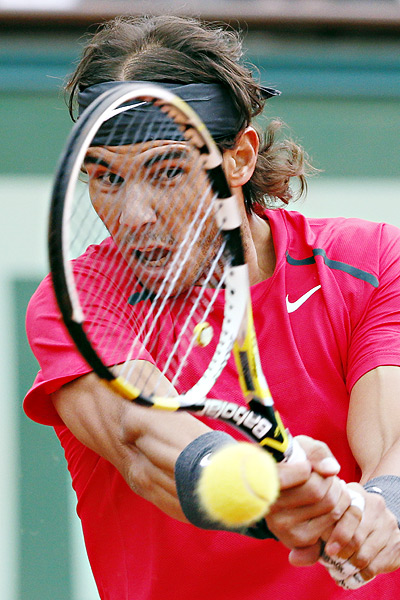
Patrick Kovarik/AFP/Getty ImagesRafael Nadal showcased not only his clay-court prowess but his mental fortitude.

"In my opinion, the conditions were much more favorable for Novak than for me," Nadal said. "At the same time, I'm playing against the best in the world. He played, in my opinion, fantastic [during those] eight games in a row. He didn't have any mistakes. He returned fantastically well. That's true that I lost meters behind the baseline. I wasn't able to push him back like I did at the beginning of the match. He was able to push me back all the time. I felt like I was in a completely negative position almost every time on that period of the match."

The narrative, both immutable yet obviously fluid, said that Nadal lacked the necessary belief to take down Djokovic when the air thinned. That was, obviously, not the case here. But one thing we know, this story of twists and turns and momentum shifts is far from over. Because both men know the other is capable of controlling this rivalry at any given moment.

"Seriously, if I say something wrong about Novak it's probably going to be a big mistake because don't forget that he won in Australia," Nadal said. "He won in Miami, played the semifinals in Indian Wells, losing 7-6 in the third. He played the final in Monte Carlo, the final in Rome and the final here."

Wimbledon is now two weeks away, and Nadal is as formidable as before -- but with the results to fortify the belief. He has played Djokovic 33 times and won 19. The margins between the two men are miniscule. Nadal may have cost himself a major with that missed backhand in Melbourne. Djokovic may have lost a sixth because it rained or because he double-faulted three times to lose games. The point is that the narratives may be fluid, but the greatness of Nadal is not.

Saumitra-II

For most part of Ramayana, Ram and Lakshmana, by most accounts, are believed to be exceptional kshatriya (warrior section of the society) princes but nothing more; they behave and feel like humans and are not known to speak explicitly of any supernatural elements they might have within them.For 12-13 years of their exile, they live quietly and slowly, unknowingly getting better and better; their bedrock of patience getting stronger;their knowledge and use of weapons, better.
Ageing has its effects on Ram and Saumitra who slowly begin to spend more of their time worshiping Shiva while still as a discipline, practicing and maintaining their weapons and tools in good shape. Saumitra is known to mirror Ram in his conduct during this period. It is only towards the end of this period, in dandakaranya , when Surpanakha abuses Sita beyond limit, an angry Saumitra cuts nose of Surpanakha. But this time, he is fully aware of his words and his actions.
After some time passes by, one day Sita manipulates Rama emotionally to chase a golden deer and bring it to her. When Sita hears Ram's cry from deep in the woods, she forces Saumitra to look for his brother. Saumitra senses some abnormal situation and does not believe that anyone could put Ram in trouble. He is not ready to leave Sita alone in the woods.When forced to leave the hut, Saumitra is known to draw a line around the hut; this is the line which Sita must not cross come what may, and any unauthorized entity crossing this line towards the hut would get destroyed. Saying this he leaves for the woods. Ravana, waiting for Laxman's departure realizes from his knowledge and senses that this was a line even he could not cross. In this flurried period of felicitous narration by Valmiki, the readers get , for the first time, an implicit indication of supernatural element in Saumitra.
On losing Sita, Ram immediately goes into shock and seems to be discombobulated. He loses self-control and self-esteem.In agitation he threatens to destroy this creation by his power. Seeing such uncharacteristic loss of self-control, Saumitra is known to have boldly and tactfully tell Rama, that destroying this creation was a very unfair view of the situation because this creation has no special interest in conspiring against Ram for his misfortunes. Ram becomes very weak and blames himself for every misfortunes and ills affecting his family. Saumitra displays level-headedness and suggests searching for Sita to be a better option.
The search for Sita and their journey further southward provide, although not definitive, evidence of the divinity of the brothers when Rama frees Devi Ahilya and some demons from their curse who are known to be waiting for ages for Ram for their salvation.
During the war in Lanka, Saumitra is known to take up initiative for killing many demons including Ankpan, and Indrajit. His encounters with Indrajit ( Meghnad) have been described vivdly in Ramayana. He has to use indrastra to beat Meghnad in the penultimate battle.
(concluded)

Saumitra-I

Ramayana is full of interesting characters. Each of them have their background and some bring their own stories to gently merge with the epic, where their stories meet their ends. Let me write about one of the very important characters of Ramayana today. The very nectar of this very great epic is a north indian prince's southward journey in exile with his younger brother and wife and ultimately waging a war against the most powerful king ever born and winning this war, to free his wife. Ramayana is too good a story to be wasted by narrating or reciting it in one monosyllabic way. It has to be looked from different angles and one might eventually ponder that who's story is it, Ram or Ravana's. For, in a broader context, several parallel stories run for generations, all of which find a climax in a special immortal combat in Lanka.
Saumitra is the prince of Ayodhya who accompanies his elder brother to a life in distant forests for 14 years. He is married to Urmila, sister of Sita. With a quiet and unnoticed separation from Urmila, he leaves for exile which was his destiny,as Saumitra, without Urmila, was to be part of a mythology to be sworn by Asian landscape for perpetuity.
Blessed with a silvery look and an unrivaled physique, commanding knowledge and practice in archery and other weapons, he is known to possess a very good demeanor. He is known to lose temper and become aggressive sometimes. Saumitra , none-the-less, is an extension of Rama's controlled aggression and manifestation of 'maryada purushottam' (the best among men in terms of behavior).Many believe that, he and some other characters of the story are incarnations of divine souls who come together to end Ravana's reign as the emperor of all worlds.Unknown to Ravana, thus is a divne plan which gradually takes shape and the story builds up , so that divine forces in a particular combination find way through the loopholes of boons granted to Ravana.

ballad

जिस से कोइ एक न जीता;
चेतक था एक राणाजी का;
जिस ने रण से पैर न खीचा;
चेतक था एक राणाजी का;

जब चेतक को एड लगा दी;
हर दुश्मन को धूल चटा दी;

राणाजी से उस का रिश्ता बडा अतूत था;
वो एक क्षत्रीय था ! वो एक राजपूत था !